
What Happens When a Neighbor’s Fence Crosses the Property Line?
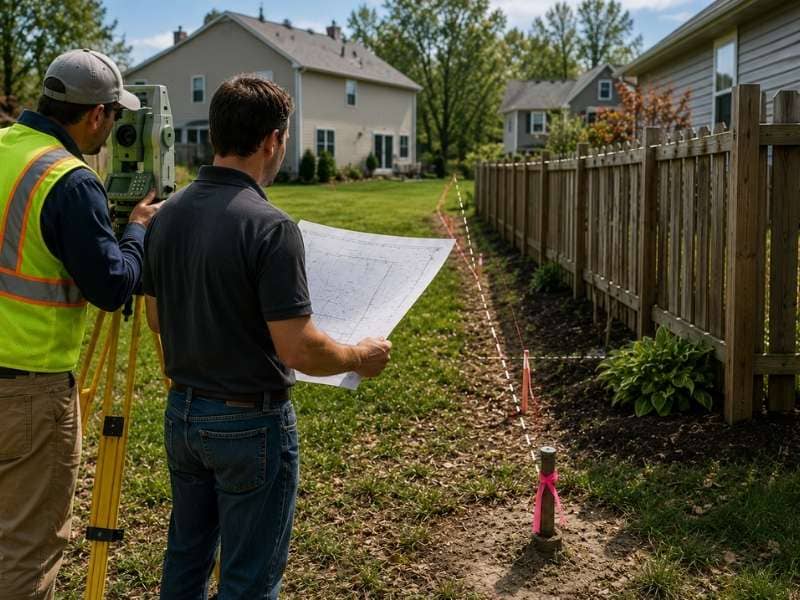
A fence between two yards looks like a clear dividing line. But fences aren’t always built where property lines actually are. If you think your neighbor’s fence is sitting on your land, the first step isn’t a confrontation. It’s learning how to find property lines so you know exactly where you stand before doing anything else.
Your Fence May Not Show the Real Property Line
A lot of fences get built without any survey at all. A homeowner eyeballs the yard, makes a guess, and puts posts in the ground. Sometimes that guess is close. Sometimes it’s off by several feet.
Even fences that were built with good intentions can be in the wrong spot. A previous owner may have used a neighbor’s old fence as a reference point, not knowing that the fence was already misplaced. One bad reference point gets passed down over the years, and the error grows.
This means you can’t rely on a fence to tell you where your property begins or ends. A fence is a structure. A property line is a legal boundary. Those two things don’t always match.
Find Property Lines Before Taking Action
It’s tempting to act fast when you think someone’s fence is on your land. But moving, replacing, or cutting a fence before you know where the true boundary sits can create bigger problems than the one you started with.
If you remove a fence that turns out to be on your neighbor’s side, you could be liable for the damage. If you build a new fence based on a guess, you might repeat the same mistake the previous owner made. Either way, acting without confirmed boundary information puts you at risk.
Finding the property line first protects you. It gives you facts instead of assumptions, and facts are a lot easier to stand behind if the situation ever involves a lawyer or a local code office.
Look for Signs of a Boundary Problem
You don’t need a survey to notice that something might be off. A few signs can tell you it’s worth looking into.
Check for property markers. These are usually iron pins or rods set in the ground at the corners of your lot. If they’re missing, buried, or clearly disturbed, the boundary hasn’t been physically verified in a while. That’s a reason to look closer.
Compare your lot to the ones nearby. If your neighbor’s fence cuts into your yard at an angle that doesn’t line up with the fence patterns on the rest of the block, that’s worth paying attention to. Straight streets and uniform lots sometimes make misplaced fences easy to spot.
Look at your property documents too. Your deed or a recorded plat map can give you a general sense of your lot dimensions. If the fence placement doesn’t match what’s on paper, a survey will tell you why.
Work Together to Solve the Problem
Boundary problems between neighbors don’t have to turn into fights. Most people would rather solve the issue quietly than go through a legal dispute that costs both sides money and goodwill.
If you think the fence is in the wrong place, start by bringing it up calmly. Don’t lead with accusations. Lead with a question. You might say you’ve been looking at your property documents and noticed something that doesn’t add up, and you’d like to get it sorted out properly.
In many cases, a neighbor doesn’t know their fence is over the line. They bought the house with the fence already there, just like you did. Approaching the conversation with that in mind makes it easier to find a solution together.
A shared survey is one of the cleanest ways to resolve the question. When both sides agree to use the same surveyor’s findings, there’s no arguing over whose measurements are right. The line is the line, and both of you can move forward from there.
A Survey Gives You Clear Answers
At some point, guessing has to stop. A licensed land surveyor finds the property line using recorded deeds, legal descriptions, and physical measurements. They locate or re-establish the corner markers for your lot and produce a document that shows exactly where your boundary sits.
That document matters. If the fence does turn out to be on your property and your neighbor disputes it, a signed and sealed survey from a licensed professional carries real weight. It’s the kind of evidence that holds up with code enforcement offices, attorneys, and courts.
A survey also protects you going forward. Once you know where the line is, you can make decisions about your yard, your fence, and your property with confidence. You’re not guessing anymore.
Frequently Asked Questions
How can I find property lines for my yard?
Start by looking at your deed and any recorded plat maps for your area. You can also look for iron pins or rods at the corners of your lot. For the most accurate result, hire a licensed land surveyor. They use legal records and physical measurements to locate and mark the true boundary.
Can a fence be on the wrong property?
Yes, and it happens more often than most people expect. Fences get built without surveys, based on guesses or old reference points that were already wrong. A fence sitting on the wrong property doesn’t change where the legal boundary is, but it can cause real problems for both property owners.
What should I do if I think a fence crosses my property line?
Don’t remove or move anything yet. Look at your property documents first and try to locate any corner markers on your lot. Then talk to your neighbor calmly. If the situation isn’t resolved through conversation, hire a licensed surveyor to find the property line and document the correct boundary.
Can I remove a fence that is on my property?
That depends on your local laws and the specific situation. In many cases, you have rights over structures that sit on your land. But acting without a confirmed survey first can lead to legal complications. Get the boundary documented before taking any physical action.
Who can find the correct property line?
A licensed land surveyor is the right person for this job. They have the training, tools, and access to recorded legal documents needed to locate and mark a property boundary accurately. Their findings carry legal weight in a way that personal measurements or old documents alone do not.
How much does it cost to find property lines?
The cost varies based on the size of the property, how much research the surveyor needs to do, and the complexity of the boundary. A basic boundary survey for a residential lot typically ranges from a few hundred to over a thousand dollars. Getting a written quote from a licensed surveyor before work begins is always the right first step.